Are Toronto Real Estate Prices Dropping? October 2026 Market Update
Last updated: October 31, 2026. Data: TRREB September 2026 Market Watch and MLS® Home Price Index. October figures are due in early November.
The Short Answer
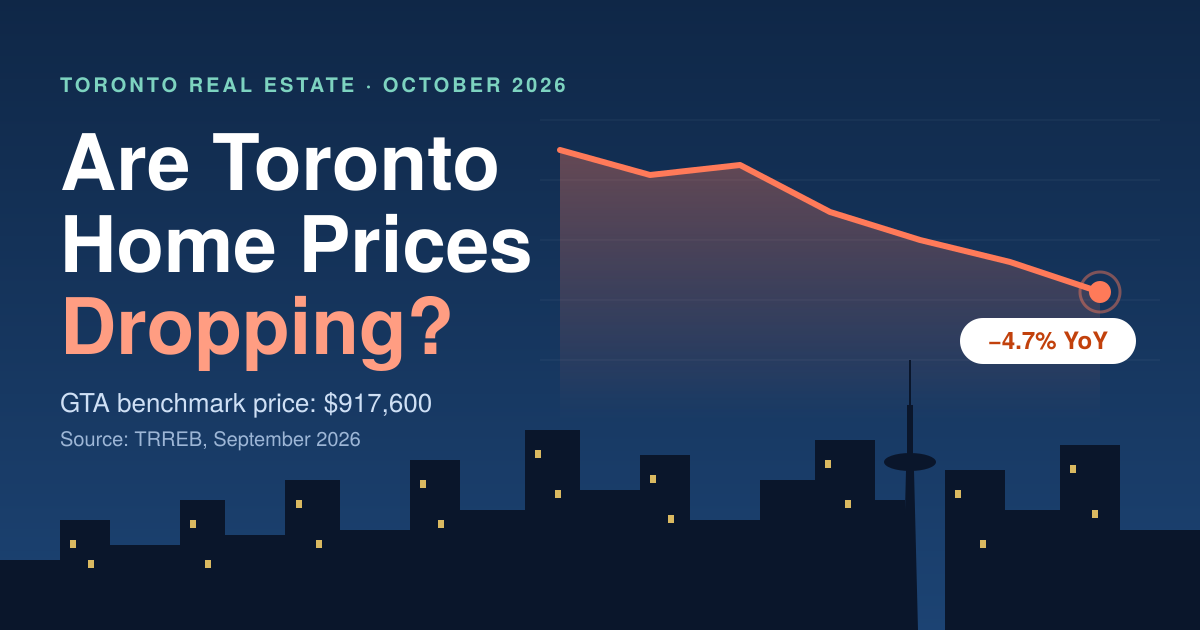
Yes, Toronto home prices are lower than a year ago, but the drop is shrinking and monthly prices have been roughly flat. In September 2026, the Toronto Regional Real Estate Board (TRREB) reported a GTA benchmark price of $917,600, down 4.7% year over year. The average sale price was $1,006,409, down 5.1%. The Bank of Canada's rate hike on October 28 adds a new headwind heading into winter.
Toronto Home Prices at a Glance: September 2026
| Measure (GTA, all home types) | September 2026 | Change vs. September 2025 |
|---|
| MLS® HPI composite benchmark | $917,600 | -4.7% |
| Average selling price | $1,006,409 | -5.1% |
| Home sales | 5,040 | -9.0% |
| New listings | 16,500 | -14.4% |
| Active listings | 26,131 | -9.3% |
| Average days to sell | 34 | +1 day |
Source: TRREB Market Watch, September 2026.
How Fast Are Toronto Prices Falling?
The pace of decline has eased through 2026. TRREB's benchmark price, which tracks a typical home and adjusts for the mix of homes sold, showed this path year over year:
- January 2026: -8.0%
- June 2026: -5.4%
- July 2026: -4.6%
- August 2026: -4.5%
- September 2026: -4.7%
So prices are still falling compared with a year ago, but the annual decline has roughly halved since January. On a seasonally adjusted monthly basis, the September benchmark edged down about 0.5% from August, according to TRREB's figures as summarized by Realtopedia. That is a drift, not a slide.
Why the Average Price and the Benchmark Differ
When you read "Toronto's average home price," you are usually seeing the average selling price. It moves with whatever mix of homes sold that month. If more condos sell, the average falls even when no individual home loses value.
The benchmark price, based on TRREB's MLS® Home Price Index, tracks a typical home of fixed characteristics. For judging whether your home or a home you want to buy has changed in value, the benchmark is the better measure. In September the two were close (-4.7% versus -5.1%), which suggests the decline is real rather than a quirk of sales mix.
Prices by Property Type
The correction is not even across the market. TRREB's September benchmarks for the whole GTA:
| Home type | Benchmark price | Year over year |
|---|
| Detached | $1,196,400 | -4.8% |
| Semi-detached / attached | $912,000 | -4.8% |
| Townhouse | $668,800 | -6.5% |
| Condo apartment | $527,200 | -6.7% |
Condos have fallen the most. Average condo prices in the GTA were down 7.7% in September, according to one analysis of TRREB data. RBC Economics reported in June that Toronto's condo affordability measure had improved to 36.1% in the first quarter, better than its 38.5% reading at the end of 2019. Toronto condos were more affordable than Montreal's for the first time in 16 years.
City of Toronto vs. the Greater Toronto Area
"Toronto" can mean the City of Toronto (the 416) or the wider GTA. They tell a similar story:
- City of Toronto average price: $1,034,320 in September, versus $1,091,216 a year earlier (about -5.2%).
- City of Toronto benchmark: $908,200, down 3.8% year over year.
- City of Toronto sales: 1,937, down 6.1%.
- Detached homes in the city: average of roughly $1.56 million, down 7.6%.
Local pockets vary. Some neighbourhoods are down by more than the city figure and some are flat. A neighbourhood-level look at recent sales is the only reliable guide for a specific street.
Why Are Toronto Prices Falling?
1. Higher borrowing costs. Prime stood at 4.70% at the big banks from October 29. Mortgage payments remain a heavy load for buyers who qualified under lower rates, and TRREB said buyers were in a "holding pattern" in September amid uncertainty over the economy, inflation and borrowing costs.
2. Weak sales. September sales were down 9% from a year earlier and down about 5% from August on a seasonally adjusted basis. Fewer buyers means less pressure on sellers to hold firm.
3. A weak condo segment. Apartments and townhouses lead the declines, and RBC described the condo correction as sharper than for other housing types.
4. Affordability limits. Even after the correction, many buyers are stretched, which caps how quickly demand can recover.
Why Haven't Prices Fallen Further?
Because supply is shrinking too. New listings fell 14.4% in September and active listings fell 9.3% year over year. Sellers who do not need to move are waiting. Homes that do sell are going for about 98% of asking price, and the City of Toronto average sale-to-list ratio was about 99%. RBC economists argued in June that a deeper pullback in demand would be needed to push prices meaningfully lower, since limited supply is helping support values.
That balance is why Toronto has seen a gradual, grinding decline rather than a crash. Using the standard rule of thumb that four to six months of inventory is a balanced market, the GTA's roughly 5.2 months of supply points to conditions that are neither strongly favouring buyers nor sellers.
On October 28, 2026, the Bank of Canada raised its policy rate by 25 basis points to 2.50%, its first increase since 2023. Governor Tiff Macklem said the move was meant to stop high energy prices from spreading into broader inflation, and the Bank said further increases may be needed but it would proceed carefully. The next decision is scheduled for December 9.
For Toronto real estate, a hike is a headwind for buyers because it pushes up variable-rate and prime-linked borrowing costs, and it can nudge up fixed rates. The Bank's own projection has inflation averaging 3% in 2027, which suggests rates will not fall quickly. Expect this to weigh on sales in the coming months. A 25-basis-point move is modest, so the more important question is whether more hikes follow.
What Is the Forecast for Toronto Home Prices?
Forecasts diverge, which is itself informative:
- TRREB: Earlier in 2026, TRREB said that if market conditions kept tightening in the second half, selling prices could move in line with 2025 levels and eventually rise. September's data show the year-over-year drop is smaller than in January but has not closed.
- Desjardins (October 2026): Ontario existing-home sales should rise nearly 5% in 2027, with average prices up about 2.4%, helped by lower prices, rising incomes and first-time buyer supports. It flagged trade tensions and oil-driven inflation as risks.
- Royal LePage (earlier in 2026): Expected modest further declines in Toronto in the second quarter, with condos the weakest segment.
Reading these together, the most defensible view is a stabilizing market with a flat-to-modestly-lower path through the winter, and a possible recovery in 2027 if inflation and rates cooperate. A rate-hike cycle is the main risk to that recovery.
What This Means for Buyers
- Negotiating room exists. With homes taking about 34 days on average to sell and closing near 98% of asking, offers below list can work, especially on condos.
- Condos offer the most discount. They are down the most and sit near late-2019 affordability by RBC's measure.
- Plan for rate risk. Stress-test your budget at higher rates, since the Bank has signalled more hikes are possible.
- Do not wait for a crash. Falling listings suggest supply is limiting how far prices can drop.
What This Means for Sellers
- Price to current data, not last year's. The typical home is worth about 4.7% less than a year ago.
- Condo sellers face the toughest conditions. Competitive pricing and strong presentation matter most.
- Timing is a trade-off. Waiting could mean a slightly better 2027, but rate hikes could also soften demand first.
Frequently Asked Questions
Are Toronto house prices dropping right now? Yes, year over year. The September 2026 benchmark price was down 4.7% from September 2025. Month to month, prices have been roughly flat to slightly lower.
What is the average home price in Toronto in 2026? The GTA average selling price was $1,006,409 in September, and $1,025,266 for the first nine months of 2026. The City of Toronto average was $1,034,320 in September.
Are Toronto condo prices dropping faster than houses? Yes. The GTA condo apartment benchmark was down 6.7% year over year in September, versus 4.8% for detached homes.
Will Toronto home prices go up in 2027? Desjardins forecasts Ontario average prices rising about 2.4% in 2027. That depends on inflation, trade conditions and whether the Bank of Canada raises rates further.
Is now a good time to buy in Toronto? It depends on your timeline and finances. Buyers currently have more negotiating leverage than in recent years, but rising rates add risk. A local broker can compare recent sales in your target neighbourhood.
Sources
- TRREB, Market Watch September 2026 and MLS® HPI tables, September 2026 (trreb.ca)
- TRREB news releases, 2026 (January through August data)
- Bank of Canada, policy rate announcement, October 28, 2026; Canadian Press text of the decision
- RBC Economics, housing affordability report, June 2026
- Desjardins forecast, reported by CP24 and BNN Bloomberg, October 21, 2026
- Royal LePage House Price Survey and Market Forecast, reported by CTV News, 2026
This article is general information, not financial advice. Market figures change monthly.
If you need more information contact Navid Sharifzadeh at 647-300-1010
.png)